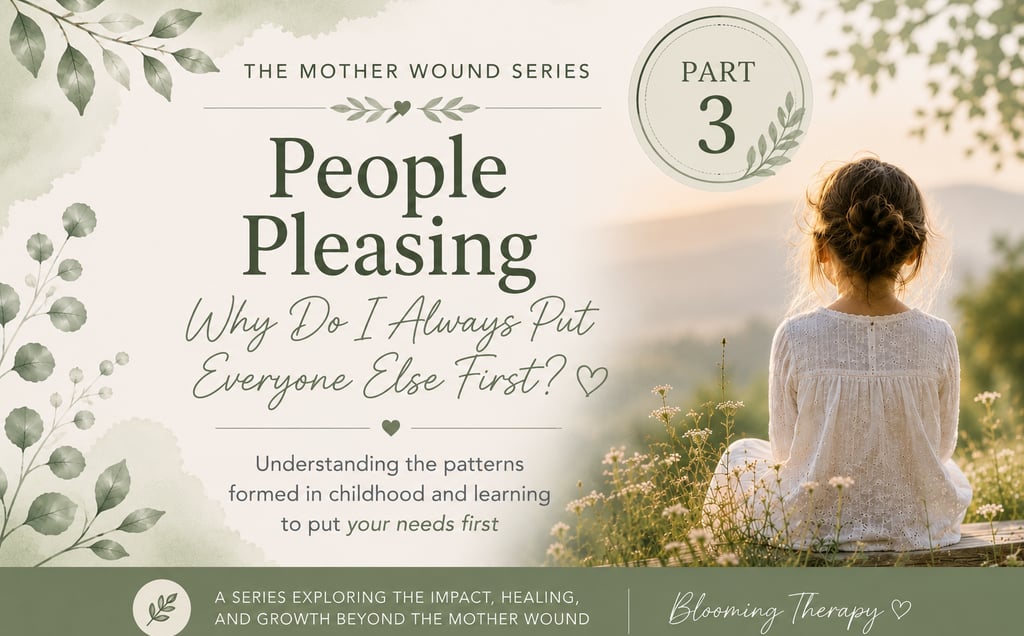
People Pleasing – Why Do I Always Put Everyone Else First?
Part 3 of The Mother Wound Series Understanding Our Past Understanding our past isn't about blaming those who raised us. It's about recognising how our earliest relationships can shape the way we see ourselves, others, and ourselves within relationships. With awareness comes choice, and with choice comes the opportunity to heal.
Introduction
Have you ever found yourself saying "yes" when every part of you wanted to say "no"?
Do you apologise when something wasn't your fault?
Feel responsible for keeping everyone happy?
Find yourself exhausted from constantly giving to other people while quietly neglecting yourself?
Perhaps people describe you as kind.
Supportive.
Reliable.
The one everyone turns to.
On the surface, these qualities appear admirable.
But underneath them there can often be anxiety.
Exhaustion.
Resentment.
And a quiet feeling that your own needs somehow matter less than everybody else's.
Many people think people pleasing is simply about being "too nice."
In reality...
It's often about survival.
Where Does People Pleasing Begin?
As children, we depend entirely on our caregivers.
Not just for food and shelter.
But for emotional safety.
We quickly begin learning what keeps us connected.
Perhaps you learnt that being quiet prevented arguments.
Perhaps you learnt not to ask for too much.
Perhaps you became the child who never caused problems.
Or perhaps you became highly tuned in to everybody else's emotions while slowly losing touch with your own.
Children don't consciously decide to become people pleasers.
Their nervous system simply adapts to the environment they're growing up in.
The behaviours that helped them feel emotionally safe become automatic.
Not because there is anything wrong with them.
Because they worked.
Good Children Often Become Exhausted Adults
Many adults who identify as people pleasers were once children who became experts at reading the room.
They noticed mood changes before anyone else.
They anticipated conflict.
They softened difficult conversations.
They took responsibility for keeping the peace.
They learnt that other people's emotions mattered more than their own.
These weren't personality traits.
They were survival strategies.
The difficulty is...
Those same strategies often continue long into adulthood.
Healthy relationships don't require one person to carry everybody else's emotional wellbeing.
Healthy relationships allow both people's needs to matter.
When Your Worth Becomes What You Do
This is perhaps one of the deepest wounds carried into adulthood.
Somewhere along the way, many people stop believing they are valuable simply because they exist.
Instead, their value becomes attached to what they do for other people.
You may recognise thoughts like:
"If I'm useful, people will keep me around."
"If I keep everyone happy, they'll love me."
"If I stop helping, they'll stop needing me."
"If I disappoint someone, I've failed."
Over time, love becomes something to earn rather than something to receive.
Your identity slowly shifts.
You become...
The helper.
The organiser.
The listener.
The dependable one.
The strong one.
The one who always says yes.
At first, these roles can feel rewarding.
People appreciate you.
They thank you.
They rely on you.
But there's a hidden cost.
You begin measuring your worth by how much you give rather than who you are.
The more you sacrifice yourself...
The more valuable you feel.
Until one day you realise you've become an expert at caring for everyone except yourself.
One question I often encourage clients to gently reflect on is this:
"If I stopped looking after everybody else... who would I believe I am?"
For many people, that question feels frightening.
Not because they don't know the answer.
But because they've never been given permission to discover it.
Healing isn't about becoming someone different.
It's about recognising that your worth was never supposed to depend upon your usefulness.
You were always worthy.
Long before you started earning your place in other people's lives.
Why Saying No Feels So Hard
For many people, saying "no" doesn't simply feel uncomfortable.
It feels dangerous.
Your body may react with guilt.
Your chest may tighten.
Your mind may immediately begin searching for ways to explain yourself.
Not because you've done something wrong.
But because your nervous system remembers a time when having needs didn't feel emotionally safe.
Your body is responding to old experiences.
Not necessarily to your present reality.
The Difference Between Kindness and People Pleasing
Kindness comes from choice.
People pleasing often comes from fear.
Kindness says:
"I'd love to help."
People pleasing says:
"I have to help."
Kindness feels generous.
People pleasing often feels draining.
The action may look identical from the outside.
The motivation underneath is often completely different.
Learning that difference can be one of the biggest turning points in therapy.
Rewriting the Programme
I often use a simple analogy in therapy.
Imagine your mind as a computer programme.
Throughout childhood, your brain is constantly writing code.
Every experience teaches it something about relationships.
If pleasing people reduced conflict...
That became part of the programme.
If putting yourself last kept you connected...
That became part of the programme too.
The programme wasn't faulty.
It was incredibly intelligent.
It learnt exactly what it needed to survive.
The wonderful thing is...
Programmes can be updated.
Therapy isn't about deleting who you are.
It's about recognising the parts of the programme that no longer help you live the life you want.
Perhaps the programme says:
"Everybody else comes first."
"My needs don't matter."
"I must earn love."
Together we begin gently updating that code.
One new belief.
One new boundary.
One act of self-compassion.
One line of code at a time.
How Therapy Can Help
Therapy offers something many people have never experienced.
A relationship where you don't have to earn your place.
Together we can explore:
where your people pleasing began
why guilt feels so overwhelming
how attachment influences boundaries
recognising your own emotional needs
building healthier relationships
developing self-worth that isn't dependent upon what you do for others
One of the most powerful moments in therapy is hearing someone quietly say:
"I didn't realise I was allowed to put myself first."
Looking Ahead
This article forms Part 3 of The Mother Wound Series.
Each blog can be read independently, but together the series explores how early maternal relationships can influence self-worth, attachment, boundaries and adult relationships.
In Part 4 – The Guilt of Saying No, we'll explore why guilt so often appears the moment we begin setting healthy boundaries, why choosing ourselves can feel so uncomfortable, and how we can begin separating guilt from genuine responsibility.
Final Thoughts
Being compassionate is a beautiful quality.
Being caring is a strength.
But neither should require you to lose yourself.
You deserve relationships where your needs matter too.
Healing isn't about becoming less kind.
It's about discovering that your kindness was never meant to come at the expense of yourself.
Because your worth has never been measured by how much you give.
Your worth has always existed.
Simply because you do.